The short answer
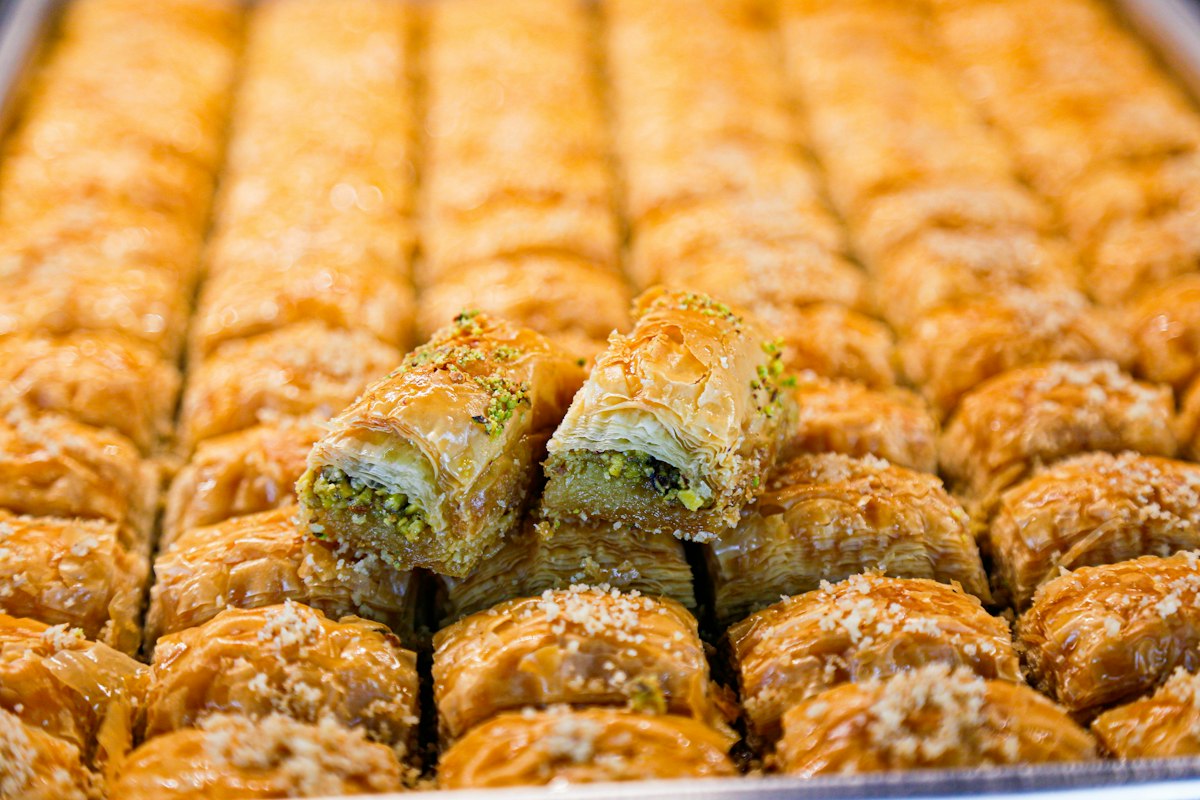
Baklava is a layered pastry of paper-thin phyllo sheets, butter, ground nuts (pistachios, walnuts, or cashews), and sugar syrup or honey. It originated in the Ottoman palace kitchens of Istanbul (possibly earlier in Assyria or Persia) and spread across the former Ottoman territories. The best baklava in Dubai is at Al Hallab, Al Samadi Sweets (Deira), Hafiz Mustafa 1864 (Dubai Mall), and Beit Al Baraka in Jumeirah.
The knife cuts through forty layers and meets no resistance. This is how you know.
Great baklava is not crunchy. It is not soggy. It exists in a state between the two that has no English word — a yielding crispness, a structured softness, a texture that collapses under the blade but holds its shape on the plate. The Turks call it "kat kat" — layer upon layer. The sound of a knife through good baklava is a whisper, not a crack.
This is the dessert that defined Ottoman hospitality for six centuries. And in Dubai — a city built by people from every corner of the former Ottoman world — baklava is not a novelty. It is a daily reality.
The Ottoman Origin (and the Arguments Before It)
Baklava's origin story is a geopolitical minefield. Turkey claims it. Greece claims it. Lebanon claims it. Syria claims it. Iran makes a compelling case. Assyria makes an older one.
What historians can agree on: by the 15th century, baklava had become the ceremonial sweet of the Ottoman palace. The Topkapi Palace kitchens in Istanbul employed dedicated baklava masters — baklavaci — who rolled phyllo so thin you could read a newspaper through it. During Ramadan, the Sultan would send trays of baklava to the Janissary corps in a procession called the Baklava Alayi — a parade of sweets through the streets of Istanbul.
The Ottoman version used 40 layers of phyllo (a number with symbolic significance in Islamic tradition), clarified butter (never oil), and pistachios from Gaziantep in southeastern Turkey — the pistachio capital of the world. The syrup was a simple sugar syrup, poured cold over hot pastry — a technique that creates the signature texture by shocking the butter-soaked phyllo into simultaneous crispness and saturation.
The Regional Schools
As the Ottoman Empire spread baklava across its territory, each region developed its own theology:
Turkish (Gaziantep Style)
The gold standard. Turkish baklava from Gaziantep uses intensely green pistachios, clarified butter (never regular butter), and a lighter syrup. The phyllo is rolled by hand to extreme thinness. The result is delicate, less sweet than Arab versions, with the pistachio flavour dominant. The best Turkish baklava makers can produce phyllo so thin that a single sheet weighs less than a gram.
Lebanese
Lebanese baklava is sweeter and uses a rose or orange blossom-scented syrup. The nut mixture often blends pistachios with cashews. The phyllo layers tend to be slightly thicker, and the overall texture is more robust — this is baklava meant for generous portions, not delicate tastings. Lebanese bakeries also produce the widest variety of shapes: diamonds, fingers (asabeh), birds' nests (osh el bulbul), and rolled cigarettes (burma).
Syrian
Syrian baklava — particularly from Aleppo — is considered by many to be the finest in the Arab world. Aleppo's baklava tradition emphasises a specific pistachio variety (Halabi pistachio) that is smaller, more intensely flavoured, and more expensive than the Gaziantep variety. Syrian baklava also tends to use less syrup than Lebanese, allowing the nut and butter flavours more prominence.
Gulf
Gulf-style baklava often incorporates saffron into the syrup and sometimes uses ghee instead of butter. The flavour profile is warmer, more aromatic, and distinctly regional.
Where to Find the Best Baklava in Dubai
Al Hallab — Multiple Locations (est. 1881)
Al Hallab's baklava display is a cathedral of sugar and phyllo. Glass cases run the length of the shop, filled with 30+ varieties — from classic pistachio diamonds to cashew burma to walnut birds' nests. Their signature mixed baklava box (AED 120-180 per kilo) is the default gift for any Arab household visit in Dubai. The pistachio fingers (asabeh) are the standout: tight rolls of razor-thin phyllo around a core of pure ground pistachio, soaked just enough to yield without collapsing.
Al Samadi Sweets — Deira
Al Samadi's baklava is Syrian in tradition — less sweet, with a higher nut-to-pastry ratio and a restrained hand with the syrup. Their pistachio baklava uses a coarser pistachio grind that gives more texture. AED 90-140 per kilo. The Deira branch still feels like a Damascus sweet shop — small, cluttered, with trays stacked behind glass and a man who wraps your box in string instead of ribbon.
Hafiz Mustafa 1864 — Dubai Mall
The Turkish contender. Hafiz Mustafa is an Istanbul institution that opened its Dubai outpost in the Dubai Mall, and the baklava is the closest you'll find to Gaziantep quality without flying to Turkey. The phyllo is noticeably thinner than the Arab versions, the butter is clarified to crystal clarity, and the pistachios are the vivid green of the Turkish variety. AED 160-220 per kilo — expensive, but the craftsmanship justifies it.
Insider tip: Order the "dry baklava" (kuru baklava) — a less-syruped version that emphasises the butter and pistachio flavours. It's what Turkish baklava purists eat.
Beit Al Baraka — Jumeirah
A smaller Lebanese patisserie in Jumeirah that has built a cult following for its baklava. The owner sources pistachios from a specific farm in southern Turkey and processes them in-house. The result is baklava with a pistachio flavour that is noticeably more intense than chain versions. AED 130-170 per kilo. They don't do delivery — you have to go to the shop, which is part of the charm.
Jabal Lebnan — Oud Metha
An old-school Lebanese bakery that has been in Oud Metha since the late 1990s. Their baklava won't win beauty contests — the cuts are sometimes uneven, the syrup distribution occasionally inconsistent — but the flavour is honest and the prices are the fairest in Dubai. AED 70-100 per kilo. This is where Lebanese families buy their everyday baklava, which tells you everything.
How to Judge Baklava
A few rules from the people who know:
- ◆The knife test: Cut a piece in half. If the layers are visible and distinct, the phyllo was properly rolled and layered. If it's a compressed mass, it was machine-made or poorly assembled.
- ◆The syrup test: Lift a piece. If syrup drips freely, it's over-soaked. If the bottom is dry and pale, it's under-soaked. The ideal baklava glistens but doesn't drip.
- ◆The colour test: The top layer should be deep gold to amber. Pale means underbaked. Dark brown means the butter burned.
- ◆The nut test: Bite into the filling. If you can identify the nut by flavour, it's fresh. If it tastes generically "nutty," the nuts are old or low-quality.
Why Baklava Endures
Baklava has survived the collapse of the empire that perfected it. It has crossed borders, adapted to new kitchens, and absorbed the flavours of every culture it touched. It is served at weddings in Istanbul and funerals in Beirut. It is the first thing an Arab grandmother offers a guest and the last thing she sends home with them.
In Dubai — a city that contains people from every former Ottoman territory — baklava is not just a dessert. It is a shared language. A Turkish engineer and a Syrian shopkeeper may disagree on everything, but they will both pause, mid-argument, to acknowledge that the baklava is good.
"My father said you can judge a city by its baklava. Dubai, he would say, is a very good city." — Lebanese bakery owner, Deira