The short answer
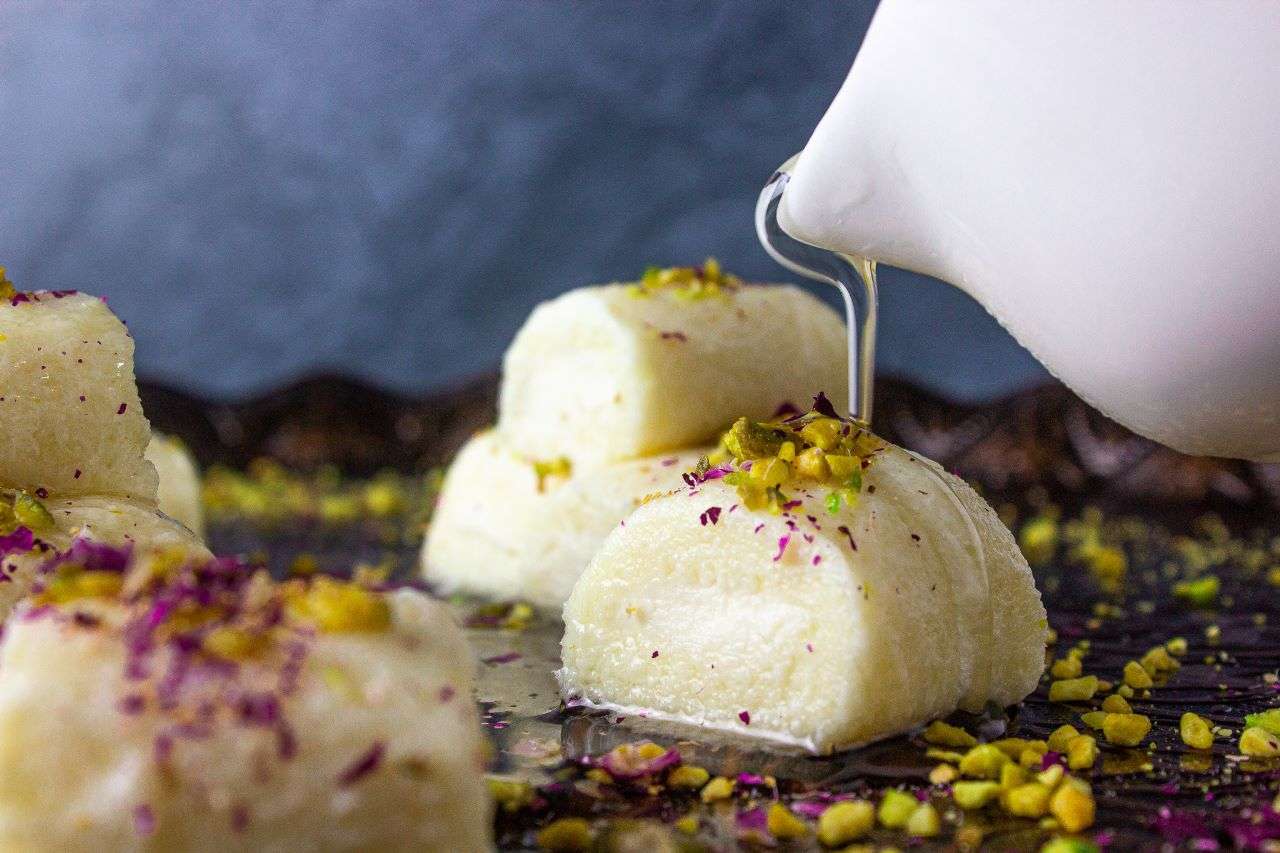
Halawet el jibn is a Syrian dessert from Homs made from a sweet cheese dough (mozzarella-like cheese cooked with semolina and sugar syrup), rolled around ashta (clotted cream), and garnished with pistachios and rose syrup. Nearly lost during the Syrian conflict, it was preserved by the Syrian diaspora in cities like Dubai. The best halawet el jibn in Dubai is at Al Hallab (multiple locations), Leila in DIFC, and Damascus Rose in Al Barsha.
The dough is made of cheese. This is the part most people can't believe.
You take Akkawi cheese — the same stretchy, white, brined cheese used in kunafa — and you cook it in a pot with semolina, sugar, and sugar syrup until it becomes a glossy, elastic dough. You roll it flat. You fill it with ashta — clotted cream made from milk, rose water, and orange blossom — and pistachio slivers. You roll it into tight cylinders, chill them, slice them, and drizzle more rose syrup on top.
The result is halawet el jibn. It tastes like nothing else in the Arabic dessert canon: the dough is chewy and faintly salty, the cream is cold and floral, and the pistachios provide a crunch that holds the whole composition together. It is, in the opinion of every Syrian you ask, the greatest dessert in the world.
A Dessert from Homs
Halawet el jibn belongs to Homs the way kunafa belongs to Nablus — absolutely, historically, and with the possessiveness of a city that knows it created something irreplaceable.
Homs, Syria's third-largest city, has been producing halawet el jibn for at least two centuries. The dessert emerged from the city's dairy culture — Homs sits in the Orontes Valley, historically one of the richest agricultural regions in Syria, and its cheese-making tradition is ancient.
The dessert was always a special-occasion food — served at weddings, Eid celebrations, and the end of Ramadan. Making it required skill: cooking cheese into dough without it seizing or becoming rubbery demands precise temperature control and timing that Homsi sweet-makers learned through apprenticeship, not recipes.
The Disappearance
When the Syrian civil war began in 2011, Homs was one of the hardest-hit cities. The old city — where many of the heritage sweet shops were located — was besieged and heavily damaged. Some of the oldest halawet el jibn makers lost their shops, their equipment, their recipes.
But the Syrian diaspora — millions of people displaced across the Middle East, Europe, and beyond — carried the recipe with them. In Beirut, in Istanbul, in Amman, and crucially, in Dubai, Syrian families and pastry chefs rebuilt what was lost.
Where to Find Halawet el Jibn in Dubai
Al Hallab — Multiple Locations (est. 1881 in Lebanon)
Al Hallab is a Lebanese-Syrian patisserie chain that traces its origins to 1881. Their Dubai branches — in Mall of the Emirates, Dubai Mall, and JBR — serve halawet el jibn that is reliably excellent. The cheese dough is smooth and elastic, the ashta cream is house-made, and the pistachio garnish is generous. AED 18-25 per portion, AED 85-120 for a box of 12 pieces.
Insider tip: Ask for the halawet el jibn to be prepared fresh — Al Hallab makes batches throughout the day, and the ones served within an hour of preparation have a softer, more supple dough.
Leila — DIFC
Leila is a Levantine restaurant in DIFC that serves halawet el jibn as part of its dessert menu — elevated, plated, with a drizzle of rose syrup and edible flowers. The portions are smaller and the price is higher (AED 45), but the quality of the ashta cream — thick, properly set, with a pronounced orange blossom flavour — makes it worth the premium.
Damascus Rose — Al Barsha
A small Syrian sweet shop in Al Barsha that has become a quiet pilgrimage site for the Syrian community. The owner, originally from Homs, makes halawet el jibn using a family recipe he brought with him when he left Syria in 2013. The dough is visibly different from the chain versions — slightly more translucent, chewier, with a higher cheese ratio. AED 15-20 per portion.
Why it matters: This is as close to old Homs as you'll find in the UAE. The shop is small, the decor is minimal, and the halawet el jibn is made by someone who learned it in the city where it was invented.
Al Samadi Sweets — Deira
Al Samadi's halawet el jibn is sold by weight from the refrigerated display case. The quality is consistent — not as artisanal as Damascus Rose, but reliable and well-priced. AED 12-15 per portion, AED 70-90 per kilo.
The Texture Question
What makes halawet el jibn difficult to replicate — and why so many restaurants get it wrong — is the cheese dough. If the cheese is overcooked, the dough becomes rubbery. If undercooked, it's grainy. If the semolina ratio is off, it's either too stiff or too soft to roll.
The perfect halawet el jibn dough should have the texture of fresh mochi — elastic, smooth, yielding to the tooth without resistance, but with enough structure to hold its cylindrical shape when sliced.
Most hotel buffet versions fail this test. They use too much semolina (cheaper, easier to work with) and not enough cheese (expensive, temperamental). The result is a dough that chews like gummy candy rather than stretching like silk.
"In Homs, we didn't call it a dessert. We called it our pride." — Syrian sweet-maker, Al Barsha