The short answer
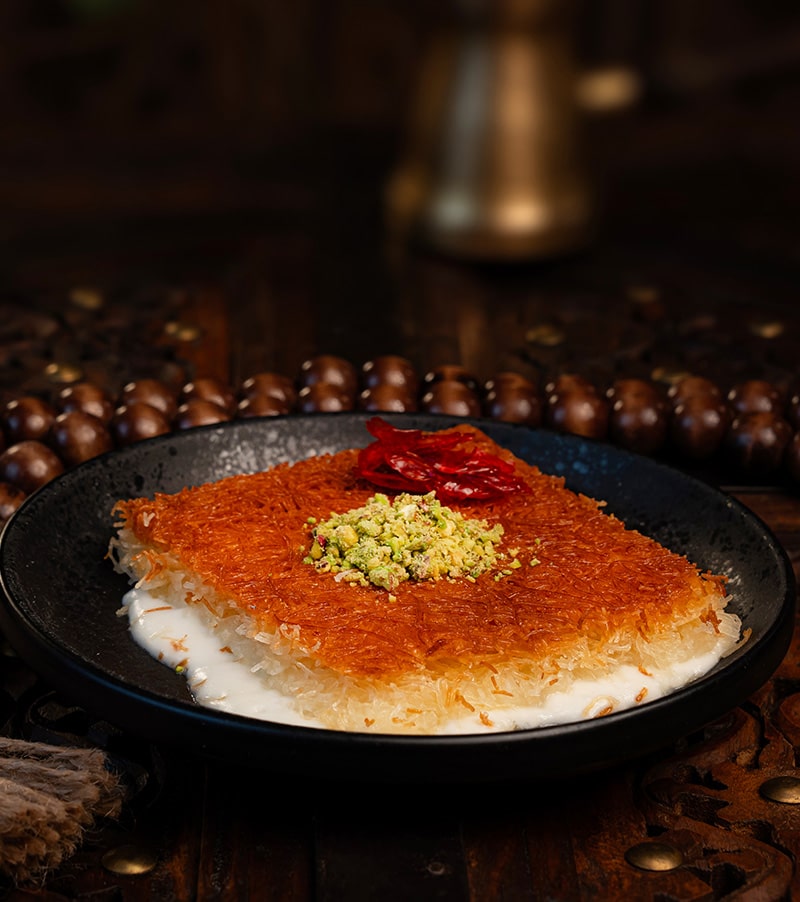
Kunafa (also spelled knafeh or kanafeh) is a Palestinian cheese pastry originating from Nablus, made with shredded phyllo or semolina dough, a molten cheese filling, and orange-blossom syrup. In Dubai, the oldest and most authentic kunafa can be found at Feras Sweets (Al Rigga, est. 1985), Al Samadi Sweets (Deira, est. 1990s), and Baba Kanafeh. Prices range from AED 8 for a single portion to AED 120 for a full tray.
The syrup hits the tray and the entire shop exhales. It's 9pm on a Tuesday in Al Rigga, Deira. The fluorescent lights wash everything in blue-white. The counter is sticky. The queue is twelve deep. And the man behind the glass is pressing a steel weight onto a copper tray of kunafa so golden it looks counterfeit.
This is Feras Sweets. It has been here since 1985. And it has been serving the same recipe — unchanged, unapologetic — for four decades.
The Nablus Origin Story
Kunafa belongs to Nablus. Not symbolically. Literally. The city in the northern West Bank has been producing this dessert for at least five centuries, and Nabulsis will tell you — with the quiet certainty of people who know they're right — that every other version is a copy.
The original kunafa naameh (smooth) uses a base of fine semolina dough pressed into a copper tray, filled with Nabulsi cheese (a white, brined cheese that stretches when heated), baked over coals until the base crisps, then drenched in sugar syrup scented with orange blossom water.
The word "kunafa" likely derives from the Arabic root meaning "to shelter" — the dough sheltering the cheese within. In Nablus, families guard their recipes with the seriousness of state secrets. Certain clans — the Aker family, the Tamimi family — have been making kunafa for generations, and their shops on the old city's market streets are pilgrimage sites.
How It Reached Dubai
The Palestinian diaspora carried kunafa across the Arab world. When Dubai's construction boom drew workers from the Levant in the 1970s and 80s, they brought their food culture with them. By the mid-1980s, sweet shops in Deira were producing kunafa for the growing Arab community — and Feras Sweets, opened by a Palestinian family in 1985, became the anchor.
What makes the Dubai kunafa story interesting isn't the dessert itself — it's how the city adopted it. Kunafa moved from a niche Palestinian treat to a citywide obsession. Today, during Ramadan, some shops in Deira sell over 500 trays a night.
Where to Find the Best Kunafa in Dubai
Feras Sweets — Al Rigga, Deira (est. 1985)
The original. Feras has been serving kunafa from the same stretch of Al Rigga Road for four decades. The naameh (smooth) is the benchmark — pressed thin, baked to a deep amber, with Akkawi cheese that pulls in strings. A single portion costs AED 8-12. A full tray runs AED 80-120.
Insider tip: Go after 9pm during Ramadan. The trays come out faster, and you'll eat it at peak temperature — when the cheese is still molten and the semolina crunches like caramel glass.
Al Samadi Sweets — Multiple Locations (est. 1990s)
Al Samadi is the chain that earned its reputation before it became a chain. The original Deira branch still feels like a Levantine sweet shop transplanted from Damascus — glass cases of baklava, trays of maamoul, and kunafa baked in copper. Their khishneh (rough, shredded phyllo) version is excellent — more texture, more crunch, a bigger visual drama.
Price: AED 10-15 per portion, AED 90-130 for a tray.
Baba Kanafeh — Al Barsha
A newer entrant, but one that has earned serious respect from the Palestinian community. Baba Kanafeh focuses exclusively on kunafa — no baklava sidelines, no distraction. Their Nabulsi-style kunafa uses imported Nabulsi cheese and is baked to order. The wait is 15-20 minutes. It's worth it.
Price: AED 12-18 per portion.
Honorable Mentions
- ◆Habibah Sweets — a Jordanian import on Sheikh Zayed Road, famous for their crowd-visible tray-flipping technique
- ◆Feras Al Nabulsi — a second-generation offshoot in Sharjah with a cult following
- ◆Street vendors during Ramadan — pop-up kunafa carts appear near mosques across Deira and Bur Dubai
The Ritual of Eating Kunafa
Kunafa is not a dessert you eat politely. It arrives on a metal plate, still sizzling. The syrup pools at the edges. You cut with a fork and the cheese stretches — six inches, eight inches, sometimes a full arm's length if the cheese is fresh and the heat is right.
The first bite is always the crunch. The semolina base shatters. Then the cheese — salty, elastic, flooding your mouth with warmth. Then the syrup — sweet, floral, cutting through the salt.
This sequence — crunch, stretch, sweet — is the reason people queue for 30 minutes at Feras Sweets on a Ramadan evening. It is the reason this dessert has survived five centuries and a dozen borders.
"In Nablus, we say kunafa is not food. It is proof that God loves us." — overheard at Feras Sweets, Al Rigga