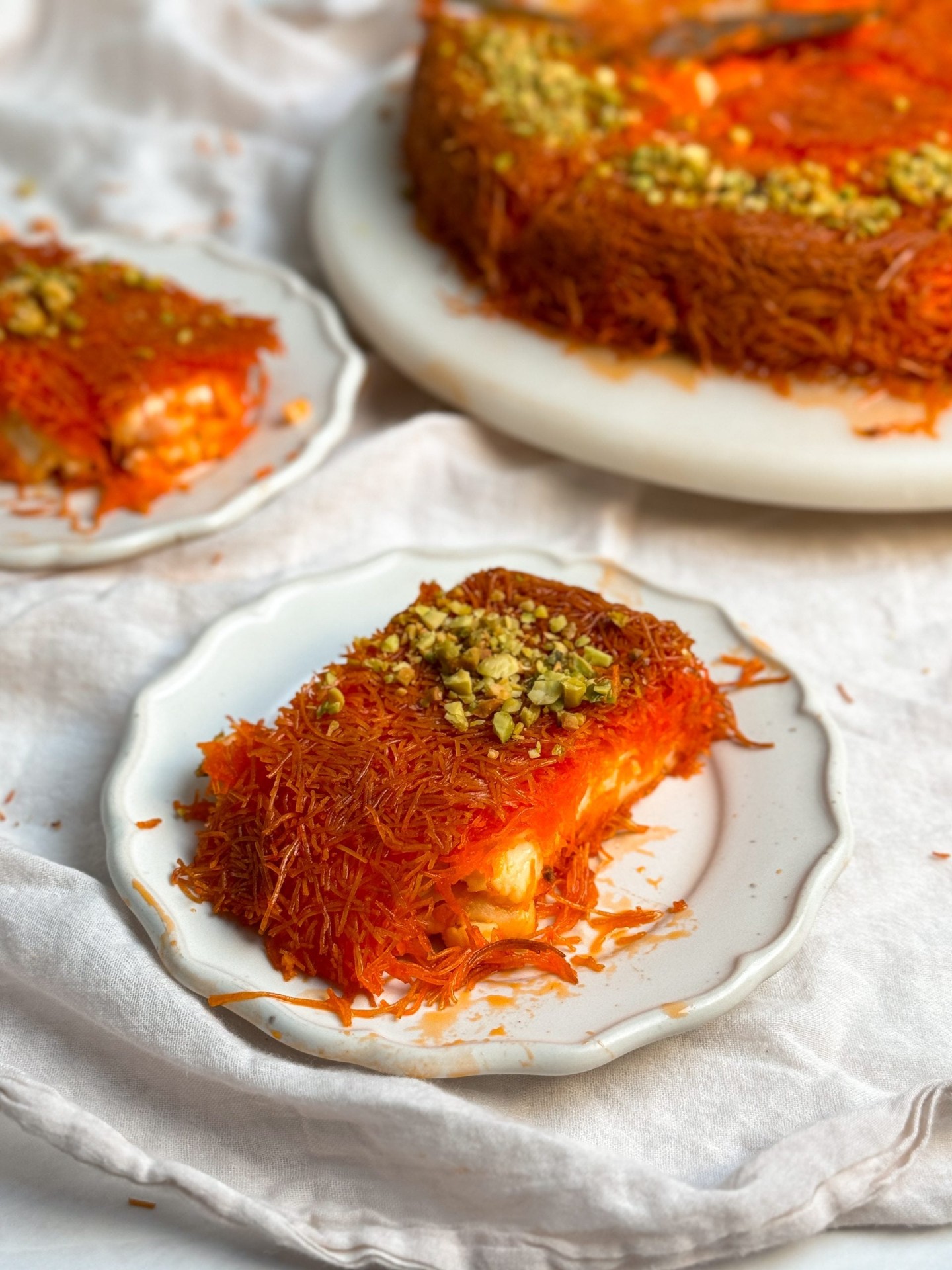
The short answer
Kunafa naameh (smooth) uses a fine semolina base and is the original Nablusi Palestinian style — crispy, caramelised, and thin. Kunafa khishneh (rough) uses shredded phyllo dough (kataifi) and is the Lebanese-Syrian style — more textured, crunchy, and dramatic. In Dubai, the best naameh is at Feras Sweets (Al Rigga) and Baba Kanafeh (Al Barsha). The best khishneh is at Al Samadi Sweets (Deira) and Al Hallab.
You can tell where an Arab is from by which kunafa they order.
If they say "naameh" — smooth, fine semolina base, pressed thin, baked until it's a single sheet of golden crunch — they're Palestinian, or raised by Palestinians, or have spent enough time in Nablus to know better than to order anything else.
If they say "khishneh" — rough, shredded phyllo threads piled high, baked until the top is a tangled nest of golden crispness — they're Lebanese, Syrian, or Jordanian. And they will tell you, with genuine conviction, that their version is superior.
This is the great kunafa debate. It has no resolution. It needs none.
Naameh: The Nablusi Original
Kunafa naameh is the older form. The word "naameh" means smooth or soft in Arabic, and it describes the base: fine semolina dough, almost like coarse flour, mixed with ghee or butter, pressed flat into a round copper tray, then baked.
The technique requires patience. The semolina must be pressed evenly — too thick and the base won't crisp properly; too thin and it burns before the cheese melts. The ideal naameh base is perhaps 3mm thick, baked over low heat (traditionally charcoal) until it reaches a deep amber colour.
When you flip the tray — and flipping is the moment of truth, the act that separates professionals from amateurs — the base should be a single, unbroken disc of golden crunch. The cheese (Akkawi, Nabulsi, or a blend) sits on top, melted and stretching, and the syrup pools in the crevices.
The naameh experience: Crunch first, then cheese, then sweetness. The semolina has a toasted, almost nutty flavour that the phyllo version lacks. It's a more subtle dessert — the contrast between the crispy base and molten cheese is binary, not layered.
Best Naameh in Dubai
- ◆Feras Sweets, Al Rigga — the benchmark. Forty years of the same recipe. AED 8-12 per portion.
- ◆Baba Kanafeh, Al Barsha — made to order with imported Nabulsi cheese. AED 12-18.
- ◆Habibah Sweets, Sheikh Zayed Road — the Jordanian import known for their crowd-facing tray flip. AED 10-15.
Khishneh: The Lebanese-Syrian Evolution
Kunafa khishneh — from "khashin," meaning rough — uses shredded phyllo dough, known as kataifi. The threads are mixed with melted butter, layered in the tray, filled with cheese (or sometimes ashta cream), and baked until the top becomes a golden, crunchy nest.
The khishneh style is more visually dramatic. The shredded phyllo creates a textured, almost chaotic surface that catches light and syrup differently than the flat naameh base. When you cut into khishneh kunafa, the threads separate and tangle on the fork, creating a messier, more tactile eating experience.
The flavour profile is different too. Shredded phyllo, when properly buttered and baked, develops a more complex crunch — multi-layered, with varying degrees of doneness from the crispy exterior threads to the softer inner ones that are steamed by the cheese.
The khishneh experience: Layers of crunch, then cheese, then a second wave of softer pastry, then sweetness. More complex than naameh, but less focused. The cheese tends to be less visible — more integrated into the pastry layers than sitting dramatically on top.
Best Khishneh in Dubai
- ◆Al Samadi Sweets, Deira — excellent khishneh with generous butter and a properly golden top. AED 10-15.
- ◆Al Hallab, Multiple Locations — the Lebanese-Syrian chain does khishneh with ashta cream instead of cheese — lighter, more floral. AED 18-25.
- ◆Ward Sweets, International City — a smaller Syrian shop producing khishneh kunafa in family-sized trays. AED 60-90 per tray.
The Hybrid: Mafroukeh
There's a third way, rarely discussed but increasingly popular: kunafa mafroukeh, which uses a coarser semolina than naameh but finer than kataifi threads. The result is something between the two — a textured base with more crunch than naameh but more uniformity than khishneh.
You'll find mafroukeh at Al Hallab and some of the Syrian sweet shops in International City. It's the compromise candidate in a debate that doesn't want one.
Choosing Sides in Dubai
The beauty of Dubai is that you don't have to choose. Within a 15-minute drive in Deira, you can eat naameh at Feras and khishneh at Al Samadi. You can compare. You can argue with the person behind the counter (they'll argue back, happily). You can change your mind.
But eventually, every resident picks a side. The naameh loyalists value purity and tradition — they want the Nablusi original, unchanged, unimproved, perfect in its simplicity. The khishneh devotees value texture and drama — they want the crunch of a hundred golden threads and the visual spectacle of the shredded top.
Both are right. Neither will admit it.
"I've served kunafa for thirty years. Every night, someone tells me the other kind is better. Every night, they come back." — sweet shop owner, Deira