The short answer
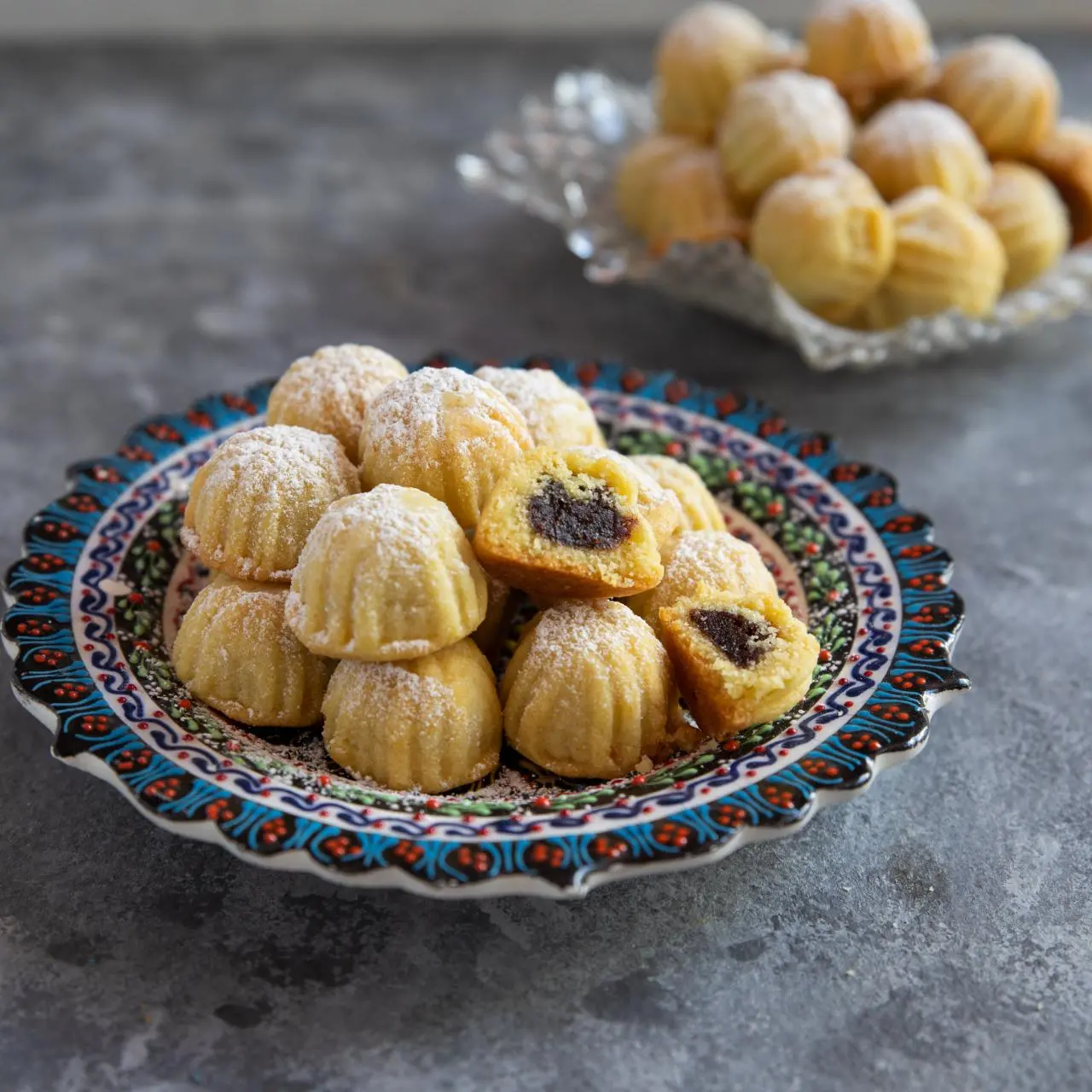
Maamoul are shortbread-like cookies filled with dates, walnuts, or pistachios, pressed into ornate wooden moulds, and dusted with powdered sugar. They are the signature sweet of Eid al-Fitr and Easter across the Levant (Syria, Lebanon, Palestine, Jordan) and have roots stretching back to ancient Mesopotamia. The best maamoul in Dubai is at Al Hallab, Al Samadi Sweets, Feras Sweets, and from home bakers who sell through Instagram before Eid.
The wooden mould has been in the family longer than the family name. It is carved from walnut — dark, oiled by decades of butter-rich dough, the pattern worn smooth at the edges but still sharp enough to stamp a perfect rosette into each cookie. The grandmother holds it the way a calligrapher holds a pen: firm, practiced, without looking.
This is how maamoul is made. Not in factories. Not yet. In kitchens, by women who learned from women who learned from women, in an unbroken chain that stretches back further than anyone can trace.
Older Than History Can Remember
Maamoul may be the oldest cookie in the world. Archaeologists have found moulds resembling modern maamoul presses in ancient Mesopotamian sites — clay stamps used to press designs into date-filled pastries offered to the gods. The Egyptians made similar filled cakes. The Romans adapted them.
But it was the Levant — modern-day Syria, Lebanon, Palestine, and Jordan — that perfected the form. By the medieval Islamic period, maamoul had taken its modern shape: a dome of buttery semolina dough, filled with either dates (the oldest filling), walnuts (the Syrian preference), or pistachios (the Lebanese luxury), pressed into a carved wooden mould called a tabi, and baked until pale gold.
The cookie was never meant to brown. A properly baked maamoul is barely coloured — ivory to pale wheat — because the semolina dough is rich enough in butter to taste cooked without needing caramelisation. Overbaked maamoul is a minor scandal in Levantine households.
The Eid Ritual
Maamoul's deepest association is with Eid al-Fitr — the celebration marking the end of Ramadan. In the days before Eid, Levantine households enter what can only be described as a maamoul production line. Grandmothers, mothers, daughters, and neighbours gather around a table covered in flour. The dough is mixed. The fillings are prepared. The moulds come out of storage.
Each person has a role. One shapes the dough into balls. One fills them. One presses them into the mould and taps them out — a single, decisive rap on the table edge that releases the cookie with its pattern intact. The finished maamoul are arranged on trays, baked in batches, cooled, and dusted with powdered sugar until they resemble small snow-covered hills.
This is not baking. This is ceremony. And in the diaspora — in Dubai, in London, in Sao Paulo — the ritual persists, even when the kitchen is smaller and the neighbours are strangers.
The Three Fillings
Date (Ajweh)
The oldest and most traditional. The dates are cooked with butter, cinnamon, and sometimes a drop of rose water until they form a smooth, dark paste. Date maamoul are typically shaped into a flat oval and stamped with a pattern of parallel lines — the visual cue that distinguishes them from nut-filled versions at a glance.
Walnut (Joz)
The Syrian favourite. Walnuts are coarsely ground with sugar, cinnamon, and orange blossom water. The filling has a rougher texture than date, and the maamoul are shaped into a tall dome — pressed into the deepest mould pattern, usually a starburst or flower.
Pistachio (Festuk)
The Lebanese pride. Ground pistachios mixed with sugar and a whisper of rose water. Pistachio maamoul are the most expensive (pistachios cost three times what walnuts do) and are considered the premium option. Shaped into a medium dome with an intricate pattern.
Where to Find the Best Maamoul in Dubai
Al Hallab — Multiple Locations
Al Hallab produces maamoul year-round but scales up massively before Eid. Their pistachio maamoul is the benchmark — generous filling, butter-rich dough, a perfect press pattern that holds through baking. AED 80-120 per kilo (mixed box). During Eid, they sell pre-packaged gift boxes with ribbons — AED 150-250 — that are the default "I'm visiting someone" gift across the Arab community.
Al Samadi Sweets — Deira
Al Samadi's maamoul leans Syrian — the walnut version is their strongest, with a coarser, more rustic texture. Their date maamoul uses Medjool dates rather than the standard Ajweh paste, giving it a lighter, more caramel-like flavour. AED 60-90 per kilo.
Feras Sweets — Al Rigga
Feras makes a Palestinian-style maamoul — slightly larger than the Lebanese version, with a thicker dough wall and a heavier hand with the powdered sugar. The date filling includes a pinch of cardamom that is distinctly Palestinian. AED 50-80 per kilo.
Home Bakers — Instagram & WhatsApp
The best maamoul in Dubai comes from home kitchens. Before Eid, Instagram fills with posts from Syrian, Palestinian, and Lebanese women selling handmade maamoul by the kilo — pressed in family moulds, baked in home ovens, delivered in foil-lined boxes. Search #maamouldubai or #aboraseid. Prices range from AED 80-150 per kilo, and quality is almost always superior to commercial versions.
Insider tip: Order at least a week before Eid. The best home bakers sell out 3-4 days before the holiday.
The Mould Matters
The tabi — the wooden maamoul mould — is itself a piece of cultural heritage. Traditionally carved from walnut or olive wood, the moulds feature geometric or floral patterns that vary by region. Nablusi moulds tend toward geometric stars. Lebanese moulds favour floral rosettes. Syrian moulds are often the most elaborate, with deep-cut patterns that create dramatic relief on the cookie surface.
In Dubai, you can buy maamoul moulds at the Spice Souk in Deira — wooden ones imported from Syria and Palestine for AED 20-50, or modern silicone versions for AED 15. The wooden ones are better. They always are.
"When my grandmother died, we divided her gold between the daughters. But the maamoul moulds — those went to whoever made the best maamoul. That was the real inheritance." — Palestinian food writer, Dubai