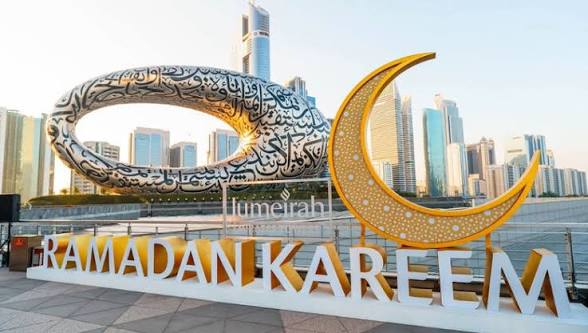
The short answer
Ramadan in Dubai is a month-long transformation where the city shifts its rhythm around fasting, feasting, and community. Restaurants screen dining areas during the day, nightlife moves to atmospheric suhoor tents, and hotel prices drop up to 40%. For visitors, it's one of the most culturally immersive — and misunderstood — times to experience the city.
The cannon fires at sunset. A hundred strangers lift dates to their lips at the same second. The sound rolls across Dubai Creek, bouncing off the wooden hulls of dhows, reaching the glass towers of Business Bay three seconds later. This is iftar — the moment 2.3 million Muslims in Dubai break their fast — and it happens every single evening for thirty days.
The City Doesn't Stop. It Shifts.
The first thing visitors notice during Ramadan isn't what's closed. It's what opens. Tents appear overnight in hotel gardens — vast, carpeted spaces with oud players and communal tables seating three hundred. Restaurants that normally close at midnight stay open until 3am. The malls, which already close late, push their hours to 2am.
Dubai during Ramadan isn't a diminished version of itself. It's a different city entirely.
What Actually Changes Day-to-Day
Between sunrise and sunset (roughly 5:30am to 6:45pm in March), Muslims fast — no food, no water, no smoking. Out of respect, eating and drinking in public is discouraged for everyone. But here's the nuance most guides miss: you can eat. Hotels serve meals behind screens. Room service runs normally. Every mall food court has curtained-off sections.
The real change is atmospheric. The pace slows. Traffic thins between 2pm and 5pm as the city exhales. Then, around 6pm, something electric happens. The streets fill. Families drive to iftar gatherings. The smell of grilled meat and cardamom drifts from every neighbourhood.
The Iftar Experience
Iftar is the meal that breaks the fast, and in Dubai it's been elevated to an event. The city's best hotels compete for the most spectacular iftar buffet — think 200-dish spreads under Arabesque chandeliers, starting from AED 189 per person at mid-range venues to AED 500+ at the palatial tents of Jumeirah and the Palace Downtown.
But the most memorable iftars cost AED 30. Head to Al Fahidi in Bur Dubai or the streets around Al Rigga in Deira. Find the tables set up on pavements with paper plates and communal pots of harees (slow-cooked wheat and lamb porridge). Strangers will wave you over. You don't need a reservation. You just need to show up.
Suhoor: Dubai's Secret Late Night
If iftar is dinner, suhoor is the after-party. This pre-dawn meal has become Dubai's most social gathering — and it runs from 10pm to 3am. The best suhoor spots feel like lounges transplanted into garden settings: think cushioned seating under fairy lights, shisha (available after iftar), Arabic coffee, and dishes designed for sharing.
Top suhoor spots for 2026:
- ◆Ewaan at the Palace Downtown — the most photographed tent in Dubai
- ◆Al Hadheerah at Bab Al Shams — desert setting with falconry shows
- ◆Katara Lounge at Jumeirah Al Naseem — beachfront with live oud
The Spiritual Side
For visitors, Ramadan offers a rare window into Islamic practice. Several mosques in Dubai open their doors for "Open Iftar" events — Jumeirah Mosque runs one every evening where visitors of all faiths are welcomed, served iftar, and given a gentle introduction to the month's significance. No pressure, no conversion talk. Just hospitality.
Is It Worth Visiting?
The data says yes. Hotel rates drop 30-40% during Ramadan. The crowds thin noticeably at attractions like the Burj Khalifa (wait times drop from 90 minutes to 20). The weather in March is perfect — high 20s, low humidity, golden light.
And then there's the intangible: the city feels warmer. People are more generous, more patient, more open. The sharpness that sometimes defines Dubai softens during Ramadan. If you've ever wanted to see the city beneath the city, this is when.